Licensed · Bonded · Insured · ROC 358358In business since 2019 · Manufacturer warranty
★ 4.9 from 74 Google reviews(602) 820-7739

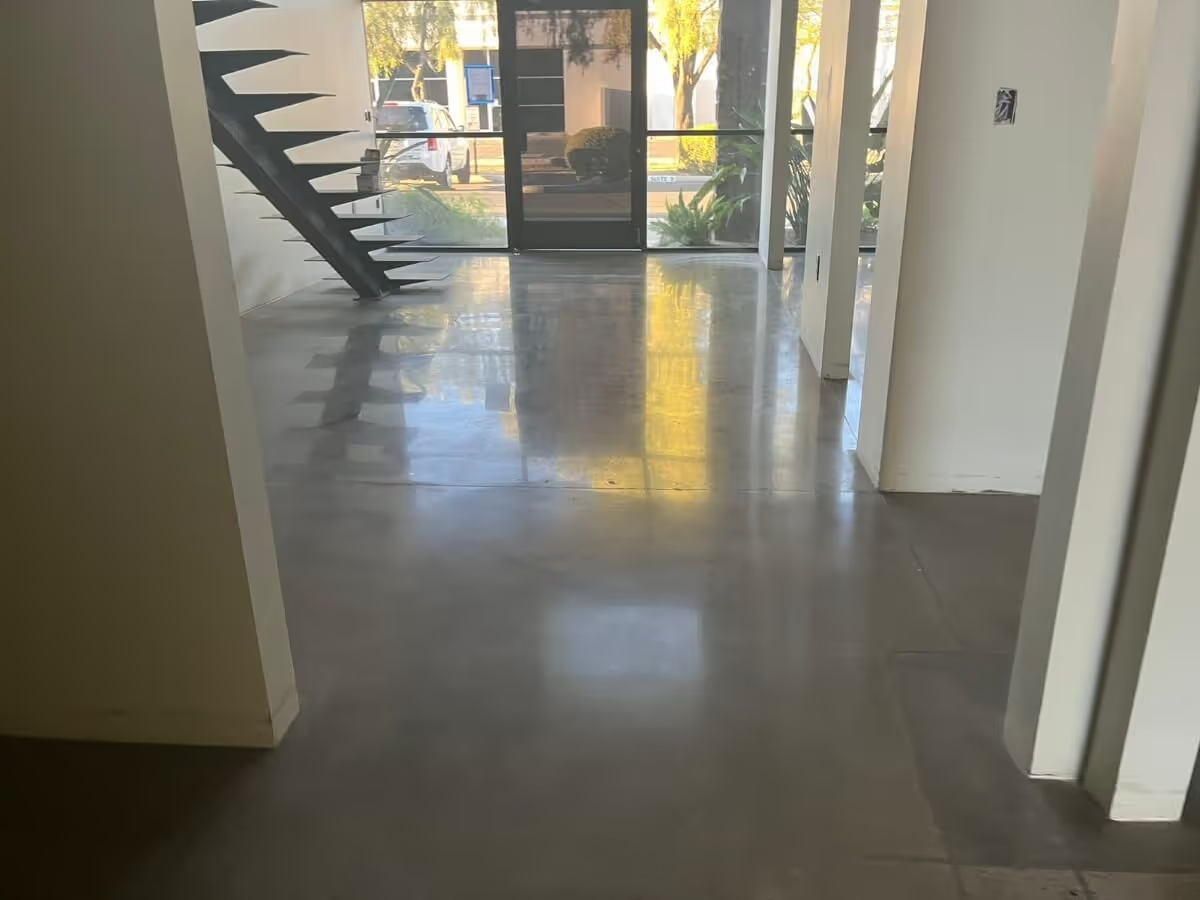
Polished concrete in Phoenix turns the slab you already have into a hard, glossy floor with no seams, grout or coating to peel. We grind it, harden it with a densifier and polish it to the sheen you choose, from matte to mirror.
Polished concrete is not a coating. It is the top of your own slab, mechanically ground with diamond tooling, chemically hardened and polished until it reflects light. Because nothing sits on top, there is nothing to chip, peel or wear through.
Polishing concrete works a lot like sanding wood. Dialed In Epoxy Flooring runs heavy grinding machines across the floor in stages, each one finer than the last, until the slab reaches the smoothness, stone exposure and shine you picked. Dust is extracted at the grinding head as we go.
It suits Arizona well. Most homes and commercial buildings across the Valley sit on concrete slabs, so a polished floor uses what is already there. Concrete floors also stay cool underfoot through a Phoenix summer and don’t hold the dust that carpet does.
Not every slab will take a polish. Where the concrete is too soft or too patched to expose cleanly, grinding and sealing it instead reaches a similar look without depending on the slab itself. If you want color, staining the concrete before the final polish adds it.

Kevin was great to work with. Listened and answered all questions to ensure we knew what to expect. Would definitely recommend.
Many Phoenix homes have a sound slab hiding under carpet or tile. When it comes up, residential polished concrete turns that slab into the finished floor, so there is nothing new to lay, no grout to scrub and nothing for pet hair or desert dust to sink into.
It works in living rooms, kitchens, hallways, casitas and covered patios. It is also a cost-effective form of concrete floor refinishing for older homes, where we fill cracks and old tack strip holes before polishing. Expect some character: saw cuts, old repairs and color variation in the slab show through, which many homeowners like.
For retail stores, warehouses, showrooms, offices, restaurants and schools, floor polishing gives a bright, hard surface that takes forklift, cart and foot traffic without waxing or stripping.
We phase large floors bay by bay so part of the building keeps working. For areas that see oil or chemicals, see our commercial epoxy flooring.
We look for coatings, adhesive, cracks and soft spots, and test hardness and moisture before quoting.
Metal-bond diamonds remove the top layer and expose the level of stone you chose.
Cracks, joints and holes are filled to match.
A lithium or sodium silicate hardener soaks in and makes the surface harder and tighter.
Resin diamonds take the floor up through finer grits, typically 100 to 800 or 1,500, until it reaches the sheen you picked.
A penetrating guard adds stain resistance and is buffed in.
You choose two things: how much stone shows, and how much it shines.
Polished concrete usually costs more to install than tile, carpet or vinyl. It tends to cost less over time, because the slab itself is the floor and does not need replacing every 10 years or so. Every floor is priced on its own slab. These are the things that move the cost:
Both are good floors; they suit different jobs. Polished concrete is the slab itself. Epoxy is a coating that sits on top.
Most slabs can. These make polishing harder or rule it out:
If yours has these, grind and seal or a coating usually gives a better result. We’ll test the slab and tell you before quoting.
Polished concrete gives Phoenix homes and businesses a hard, bright floor that outlasts most floor coverings, because the slab you already have becomes the finished surface. It works in homes, retail stores, warehouses, showrooms, offices, and medical and educational buildings.
The polished surface is the hardened slab itself, so there is no coating to chip or peel. It takes heavy foot traffic, carts and furniture without waxing. With heavy use, the guard is refreshed every few years; the floor itself does not need replacing.
A dry dust mop daily and a damp mop with a pH-neutral cleaner weekly is all it needs. There is no wax, no stripping and no grout to scrub, which cuts maintenance time and cost.
Using your existing slab as the floor means no new flooring material to buy. Over 10 to 20 years, it avoids the replacement cycle of carpet, vinyl or tile.
A polished surface reflects light, so rooms, aisles and showrooms look brighter with the same fixtures. It gives a clean, professional look in an office, restaurant, hotel, store or home.
Polished concrete is becoming increasingly popular as a flooring option in Phoenix, Arizona due to its durability, low maintenance, and sleek appearance. However, many people have questions about this type of flooring. Here are some of the most frequently asked questions about polished concrete.
It is one of the lower impact floors available, and the reason is simple: polishing works with the slab that is already there. No new floor material is manufactured, nothing is torn out and sent to landfill, and there is no coating to strip and replace later. Modern concrete mixes can also carry recycled glass, metal or marble chips, and a polished floor needs no wax or stripping chemicals to maintain.
Clean, dry polished concrete is not slippery, and it typically has more grip than polished marble or glazed tile. It can get slick when wet or dusty, so mats at exterior doors help. For patios and pool areas we recommend a matte finish.
Neither is better everywhere. Polished concrete suits homes, retail and warehouses with a sound slab. Epoxy and polyaspartic coatings suit garages, workshops and slabs with heavy patching, because they cover flaws and resist oil and chemicals.
Yes, but we usually recommend epoxy flake for garages. Garage slabs see oil, brake fluid and road grime, and a sealed coating handles those better than a polished surface.
Most homes take 2–4 days, while commercial and industrial spaces can take longer, depending on size, conditions and what is on the slab now. You can walk on the floor as soon as we finish.
Usually, yes. We remove the adhesive, fill tack strip holes and cracks, and polish. If the slab is too patched or soft, we'll recommend grind and seal or a coating instead.
Dust mop daily and damp mop weekly with warm water or a pH-neutral cleaner made for polished concrete. Wipe up spills quickly, especially acidic ones like wine, citrus or vinegar, and avoid bleach and ammonia.
The floor itself lasts as long as the building, because it is the slab. The guard on top is refreshed every few years in busy areas, and a polished floor typically goes 10 to 20 years before it needs a full re-polish.
Need a coating instead? We install premium concrete floor coatings across Phoenix too.
We polish concrete across the Phoenix Valley, including Scottsdale, Mesa, Chandler, Gilbert, Tempe, Glendale, Peoria, Surprise, Goodyear, Avondale, Buckeye, Queen Creek, Ahwatukee, Paradise Valley, Fountain Hills and Cave Creek.